
Here is the professional of the content on finned tube condensers:
Finned tube condenser is a high-efficiency heat exchange device that enhances heat transfer by increasing the surface area of the fins. It is widely used in refrigeration, air conditioning and industrial fields.
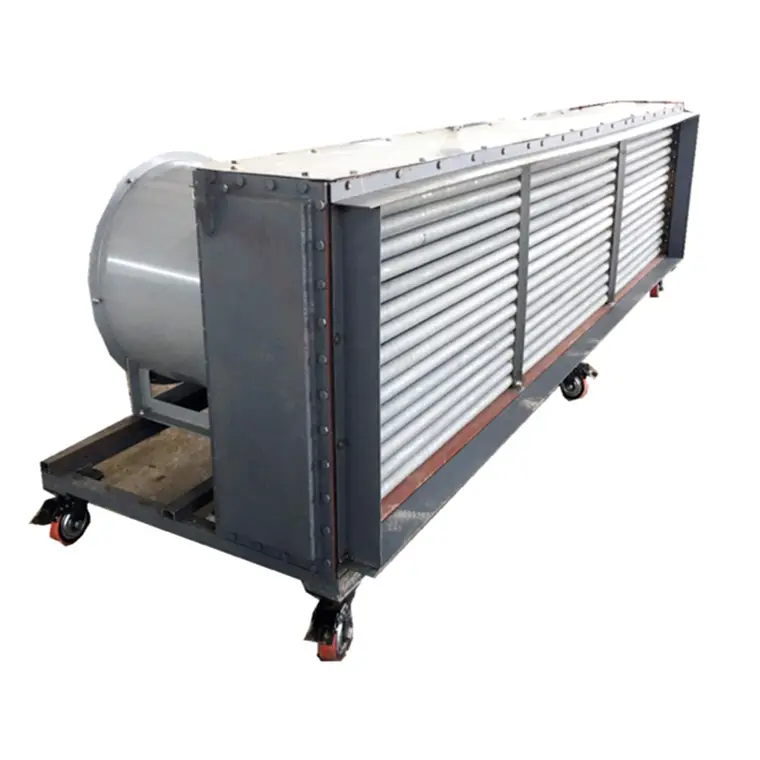
🔧 I. Structural Features
-
Core Components
- Finned Tube Bundle: Comprises base tubes (copper, stainless steel, or aluminum) tightly bonded to fins (typically aluminum or copper) via processes like high-frequency welding or mechanical expansion. Fin types include plain, wavy, or serrated designs, significantly increasing heat transfer surface area.
- Casing & Headers: Corrosion-resistant casing encloses internal components; headers ensure uniform refrigerant distribution across tubes for balanced heat transfer.
- Support Frame: Steel framework provides structural stability for long-term operation.
-
Design Optimization
- Fin spacing (1.5–4 mm) and thickness (0.1–0.6 mm), combined with staggered/inline tube arrangements (e.g., equilateral triangular layout), induce turbulence and vortices to enhance thermal efficiency by 30%+.
- Compact design achieves high surface density: up to 137 m²/m³ (condensers) or 97 m²/m³ (evaporators).
🌡️ II. Working Principle
-
Heat Transfer Process
- Condensation Phase: High-pressure vapor refrigerant flows through tubes, releasing heat via tube walls to fins; air/coolant absorbs heat from fins, condensing refrigerant to liquid.
- Enhanced Heat Transfer: Fins expand surface area 5–10x; fluid dynamics (e.g., longitudinal vortex generators) disrupt boundary layers, boosting heat transfer coefficients.
-
Cooling Methods
- Air-Cooled: Forced/natural convection (fans) for water-scarce applications (e.g., AC units, automotive condensers).
- Evaporative: Water spray + airflow leverages latent heat for industrial-scale cooling (e.g., large refrigeration plants).
🏭 III. Manufacturing & Materials
-
Production Process
- Base tube cutting → Fin forming → High-frequency welding/brazing → Casing assembly → Leak testing → Performance validation.
- Critical welding ensures minimal contact thermal resistance between fins and tubes.
-
Material Selection
- Standard: Copper tubes + aluminum fins (high conductivity, cost-effective).
- Corrosive Environments: Stainless steel fins/tubes (resists chemicals, oxidation; ideal for chemical/power industries).
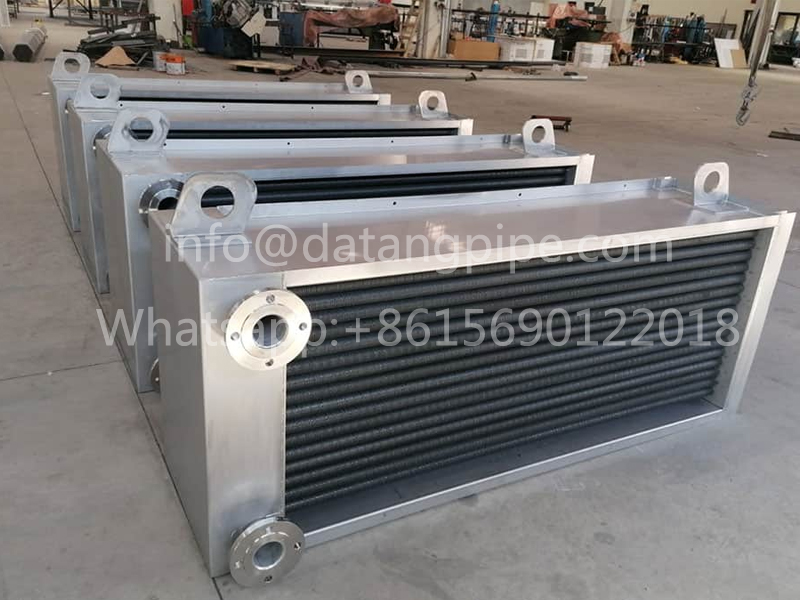
🏭️ IV. Applications
| Industry | Applications | Technical Advantages |
|---|---|---|
| Refrigeration/AC | Residential AC condensers, refrigerator coils, chiller outdoor units | Compact, high-efficiency, withstands frequent cycling |
| Industrial Cooling | Chemical reactor cooling, pharmaceutical freeze-drying, food processing | Corrosion-resistant stainless steel, handles high P/T conditions |
| Waste Heat Recovery | Power plant exhaust heat recovery, steel mill flue gas utilization | Tolerates >800°C, enhances energy efficiency |
| Transportation | Automotive AC condensers, rail HVAC systems | Lightweight, vibration/shock-resistant |
🚀 V. Advantages & Limitations
- Advantages:
3–5x higher heat transfer vs. bare tubes; 20%+ energy savings; compact size; low maintenance; 10–15-year service life. - Limitations:
Fin gaps prone to dust accumulation (require cleaning); surface corrosion in high humidity (mitigated by coatings).
💎 Conclusion
Finned tube condensers excel as core heat exchange components via enhanced surface area and modular design. Innovations like nano-coatings (anti-fouling) and smart variable-speed control will expand their role in green energy and precision industries.